

Cabins & Ships
8 min read
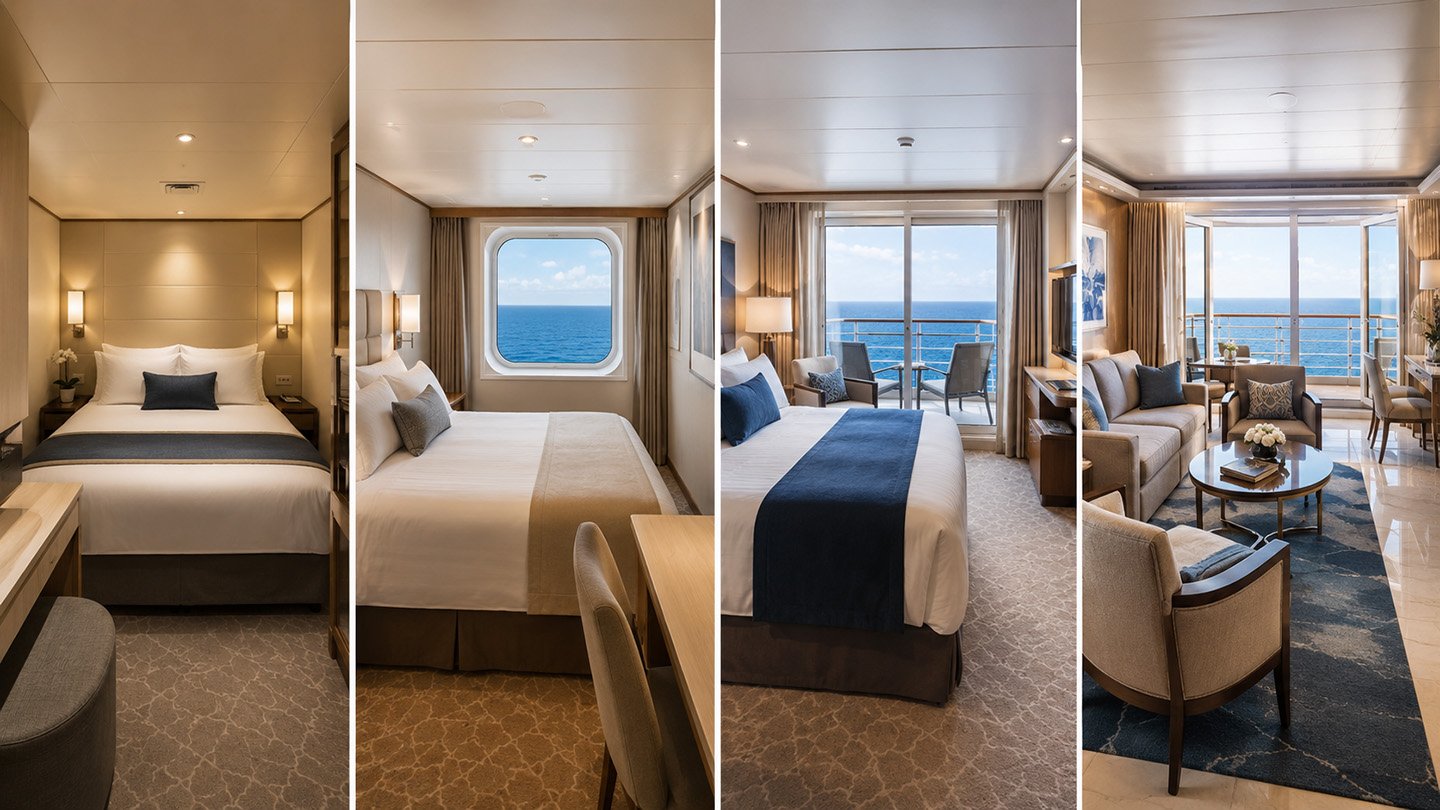
Every cruise ship organizes its cabins into the same four broad categories, even though the names and exact square footage vary by cruise line. Knowing what each one actually gives you — not just what the brochure photo suggests — makes it much easier to decide where the extra money is worth spending, and where it isn't.
Interior cabins have no window at all. Many newer ships fit them with a virtual balcony — a screen showing a live or recorded ocean view — which softens the effect without changing the actual size of the room. They are consistently the least expensive way to be onboard, and identical in bed, storage, and bathroom to an oceanview cabin on most ships. The trade-off is entirely about light and orientation: with no window, it's easy to lose track of time of day, and some first-time cruisers find that disorienting on longer sailings.
Oceanview cabins add a window or a fixed porthole, but no door to a private outdoor space. The natural light is the main upgrade over an interior cabin; the footprint is usually the same. On itineraries with dramatic scenery — a glacier approach in Alaska, a canal transit — the difference in what you can see from your own bed is bigger than the price gap suggests. On an itinerary made up mostly of open-ocean sea days, though, the view is often just water, and the upgrade matters less.
Balcony cabins add a private outdoor space with a door you can open. This is where most repeat cruisers eventually land: morning coffee with a private view, fresh air without getting dressed for the public deck, and a place to watch a port arrival that doesn't involve fighting for rail space with a few hundred other passengers. It's the single upgrade most worth paying for on any itinerary where the scenery itself is part of the appeal, and the one category most cruisers say they'd never go back from once they've tried it.
Suites vary the most between cruise lines, but generally combine a larger balcony, a separated living area, upgraded bathroom fixtures, and priority perks — earlier boarding, dedicated dining venues, sometimes a butler or concierge, priority tender access at anchor ports. The jump in price from balcony to suite is usually larger than any previous step, and the value is more about the perks — priority everything, a genuinely separate living space — than the extra square footage alone. On some ships, the top suite categories also unlock an entire private area: a separate sun deck, restaurant, or lounge reserved for suite guests only.
| Category | Outdoor space | Typical price tier | Best for |
|---|---|---|---|
| Interior | None | Lowest | Budget-focused travelers, short sailings |
| Oceanview | None — window or porthole | Modest step up | Natural light without the balcony cost |
| Balcony | Private balcony | Mid-range | Scenic itineraries, most repeat cruisers |
| Suite | Larger balcony, separate living area | Highest | Special occasions, priority perks |
Scroll the table sideways to compare all four categories.
Location matters as much as category. Cabins near the middle of the ship, on a middle deck, feel the least motion — worth prioritizing if you are prone to seasickness, since the bow and stern pitch and roll noticeably more in any kind of swell. Cabins directly under the pool deck, the buffet, or near an elevator bank can pick up early-morning noise from deck chairs being moved or service carts making their rounds well before a reasonable wake-up time. Cabins near the theater or a nightclub can pick up bass through the walls into the late evening. None of this shows up on a standard deck plan — it's the kind of detail worth asking about specifically before you book a cabin that looks identical to every other one in its category.
Connecting and accessible cabins. Families or groups traveling with children often want connecting cabins — two staterooms with an interior door between them — which exist on most ships but sell out early and are worth requesting as soon as you book rather than after the fact. Accessible cabins, built with wider doorways, roll-in showers, and lowered fixtures, exist in limited numbers on every ship and are genuinely scarce — travelers who need one should book as far in advance as possible and confirm the specific features against their needs, since "accessible" covers a range of different adaptations depending on the ship.
Not every ship follows the same four-tier system. Some luxury lines build all-suite or all-balcony ships, where even the entry-level cabin includes a private veranda — the categories still exist, but the floor is higher across the board. A few mainstream ships, particularly older or smaller ones, skip one category entirely. It's worth checking the specific ship's deck plan rather than assuming every cruise line offers all four tiers on every vessel.
Solo travelers face a different cabin math. Most cabin pricing is based on double occupancy, and a solo traveler booking any category typically pays a "single supplement" — often 150–200% of the per-person double rate rather than a simple 100%, since the cruise line is pricing the cabin, not the person. A small but growing number of ships now build dedicated solo cabins, priced without the supplement, usually in the interior category — worth asking about specifically if you're traveling alone and the supplement is a real factor in your decision.
Family cabin configurations vary more than the deck plan icon suggests. A cabin listed as sleeping four might use a sofa bed, a fold-down upper berth, or a fully separate third and fourth bed, and the difference matters a great deal for a family with young children versus two teenagers. It's worth confirming the actual bedding configuration for a specific cabin number rather than assuming based on the stated maximum occupancy alone.
A handful of specific locations are worth actively avoiding regardless of category: cabins directly above the ship's engine or thruster spaces can carry a low mechanical vibration, most noticeable at the stern and typically disclosed in the deck plan if you know to look for it. Cabins at the very front of a lower deck can feel the ship's motion more than midship cabins on the same deck, for the same reason a seesaw moves more at its ends than its center.
Booking timing affects your options more than most people expect. The best cabin locations within any category — midship, away from noise sources, with an unobstructed view — sell first, sometimes many months before sailing. Booking early gets you an actual pick of location; booking closer to the sailing date often means choosing from a "guarantee" cabin, where you're confirmed in a category but the specific room is assigned later, sometimes as an upgrade at no extra cost, sometimes simply wherever is left.
Researching a specific cabin number before you book is worth the extra step once you've narrowed down a category — independent deck-plan resources let you check a cabin's exact position relative to elevators, stairwells, and public spaces, and often include cruiser-submitted notes about noise or obstructed views for that exact room. A category is a starting point; the individual cabin number is where the real experience gets decided.
Some lines now run "upgrade bid" programs after final payment, letting you name a price for a higher category and be automatically upgraded if it's accepted — a way to end up in a nicer cabin for less than the standard fare difference, worth checking for on your specific booking a few weeks before sailing.
Cabin categories and even individual deck plans differ meaningfully between cruise lines, which is where a second opinion is genuinely useful before you book — we can tell you not just which category fits your budget, but which specific cabin location on which specific ship is actually worth the upgrade.
Keep reading
More from the Journal.
What's Actually Included in Your Cruise Fare
Read the article

Is Online Check-In Necessary? Yes — Here's Why
Read the article

What Happens If You Miss the Ship?
Read the article