

Getting Started
Explora Voyage · 10 min read
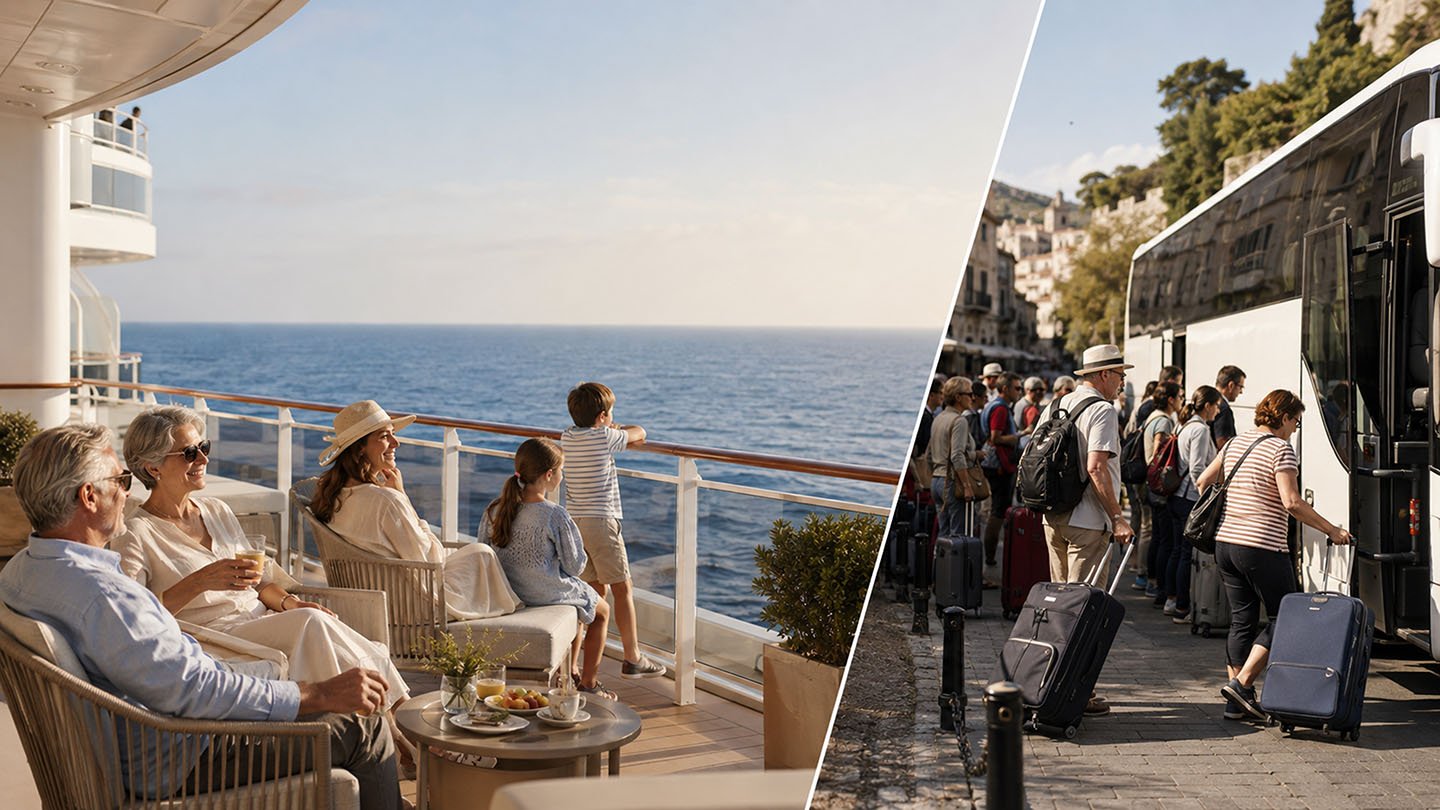
Both a cruise and an escorted bus tour promise the same basic idea: someone else handles the logistics, and you see a string of places without driving yourself between them. Where they genuinely differ is in what happens to you overnight, and what that one difference does to the rest of the trip — the packing, the pacing, the cost, and even how tired you feel by day seven.
On a bus tour, you sleep in a hotel, wake up, pack your suitcase, and load it back onto the bus — every one or two nights, for the length of the trip. On a cruise, you unpack exactly once. The ship travels while you sleep, and you wake up somewhere new with your things already where you left them. Over a ten-day trip, that difference alone can save several hours of packing and several nights of hunting for a hotel luggage cart, and it matters more than it sounds like it should once you're actually living it day to day.
The second difference is what is bundled into the price you already paid. A cruise fare typically includes your room, most of your meals, and a working entertainment program for the evenings you're not in port. A bus tour's price usually covers transport and lodging, with meals frequently on your own once you're off the coach — which adds up, and adds decision fatigue, across a two-week trip, in a country where you may not speak the language or know which restaurant near the hotel is actually worth the stop.
| Factor | Cruise | Bus / Coach Tour |
|---|---|---|
| Packing | Unpack once for the whole trip | Repack every one to two nights |
| Travel time | Mostly overnight, while you sleep | Daytime hours spent on the road |
| Meals | Most meals included in the fare | Often on your own between stops |
| Evening options | Entertainment, lounges, and dining onboard every night | Whatever the hotel or town offers |
| Ground covered | Ports across a region, often multiple countries | Denser coverage within a single region |
| Pace | Fixed port days, free sea days | Fixed daily itinerary, little downtime |
| Best for | Travelers who want variety with less logistics | Travelers who want to go deep on one specific region |
Scroll the table sideways to compare both columns.
None of this makes a bus tour the wrong choice. If your goal is to spend real time in three or four cities in one country — walking their neighborhoods, eating in their restaurants, sleeping in the middle of them rather than offshore — a coach tour gets you closer to the ground. A cruise, by contrast, gives you a taste of many places rather than a deep stay in one, and that taste is exactly what some travelers want on a first trip to a region before deciding where to go back and explore properly.
The real cost comparison. On paper, a cruise and a bus tour of similar length often land close to the same headline price, which leads a lot of travelers to compare the wrong numbers. The more useful comparison is cost per day once the extras are counted. A bus tour's extras tend to be meals not included, an optional excursion fee at almost every stop, and a single supplement that can add 50 to 100 percent to the cost for a solo traveler sharing no room. A cruise's extras tend to be gratuities, a beverage package if you want one, and shore excursions priced per port rather than baked into the itinerary. Neither is free of hidden costs — the honest answer is that both require the same discipline: read the inclusions list closely before you compare two numbers that only look similar on the surface.
Breadth versus depth. A one-week Mediterranean cruise might visit five ports across three countries; a one-week bus tour through the same region might visit two or three cities in a single country, with far more time at each one. Neither is objectively better — it depends on what you're actually there for. If this is a first trip to a region and you want to sample several countries before deciding where to go back and explore properly, the cruise's breadth is the advantage. If you already know you want to spend real time walking a specific city's neighborhoods and getting a genuine feel for one place rather than five, the bus tour's depth wins.
Comfort and accessibility. This is where the difference tends to matter most for older travelers, and it's rarely mentioned in the marketing for either option. A cruise ship is a stable, air-conditioned, single building you learn your way around by day two — no daily transfers, no new hotel layout to figure out each night, no climbing on and off a bus with your luggage. A multi-day coach itinerary, by contrast, usually means several hours of seated travel between stops, which can be genuinely tiring regardless of age, and a new hotel room — with its own quirks — every one or two nights. For travelers managing mobility issues, or simply wanting to unpack their routine along with their suitcase, the cruise's stability is a real, practical advantage, not just a marketing point.
Who each option truly suits. A cruise tends to suit travelers who want variety without the logistics, families who value onboard activities for different age groups, and anyone who finds daily hotel changes exhausting rather than exciting. A bus tour tends to suit travelers who have already narrowed down exactly which country or region they want, who prioritize walking tours and local guides over onboard entertainment, and who don't mind — or actively prefer — being based on land in the middle of things rather than offshore at the end of the day.
A day in the life of each. On a bus tour, a typical day might start with an early breakfast, a mid-morning departure, three to five hours on the road with a stop or two, arrival at the next city by mid-afternoon, a guided walking tour, free time for dinner on your own, and an early night ahead of tomorrow's departure. On a cruise, a typical port day starts with breakfast onboard, disembarking whenever you choose within the ship's shore hours, a full day to explore or take an excursion at your own pace, a return to the ship by early evening, and dinner, a show, and the full range of onboard amenities waiting exactly where you left them. The bus tour day is built around getting to the next place; the cruise day is built around getting back to the ship, with much more discretion over how the middle of the day actually unfolds.
Motion sickness works differently on each, which surprises people who assume a ship is automatically worse. A large modern cruise ship, especially in a cabin midship on a lower-middle deck, is remarkably stable in typical conditions — many first-time cruisers who worried about seasickness never notice any motion at all outside genuinely rough weather. A multi-day coach itinerary, especially through mountainous or winding terrain, can affect motion-sensitive travelers just as much, if differently — and unlike a ship, there's no option to simply move to a more stable part of the vehicle mid-journey. Neither option is inherently worse for motion sensitivity; it depends more on the specific itinerary and cabin or seat than on the mode of travel itself.
The two can be combined rather than treated as an either-or choice. A growing number of travelers book a short pre- or post-cruise land stay to get a few days of deep, on-foot time in one city, then join a cruise for the broader regional coverage — getting genuine benefits of both approaches on a single trip. If you're drawn to elements of both, this hybrid approach is worth discussing rather than assuming you have to choose exclusively.
| Day | Cruise Itinerary | Bus Tour Itinerary |
|---|---|---|
| 1–2 | Embark in Barcelona; sea day en route | Arrive Barcelona; two nights, city touring |
| 3 | Marseille, France (day in port) | Travel to Nice; one night |
| 4 | Florence/Pisa via Livorno (day in port) | Travel to Florence; two nights |
| 5 | Rome via Civitavecchia (day in port) | Full day touring Florence and Tuscany |
| 6 | Naples/Pompeii (day in port) | Travel to Rome; two nights |
| 7 | Sea day | Full day touring Rome |
| 8–10 | Sicily, then disembark in Rome | Travel to Naples and the Amalfi Coast; final touring days |
Scroll the table sideways to compare both ten-day routes.
The cruise itinerary above covers five countries in ten days; the bus tour covers one, in far greater depth. Neither route is more "correct" — they're simply built around different goals, and seeing them side by side often makes the choice clearer than any general description can.
If flexibility and unpacking once matter more to you than deep immersion in one country, a cruise is very likely the better fit for this particular trip — and if you already know you want a slower, land-based pace instead, that's worth telling us too, since we can point you toward the itinerary style that actually matches rather than defaulting to what's easiest to sell. Choosing the right ship, cabin, and itinerary for your travel style is exactly what we help with.
Keep reading
More from the Journal.
Types of Cruise Cabins — and Which One Is Right for You
Read the article
What's Actually Included in Your Cruise Fare
Read the article

Is Online Check-In Necessary? Yes — Here's Why
Read the article