

River vs Ocean
9 min read
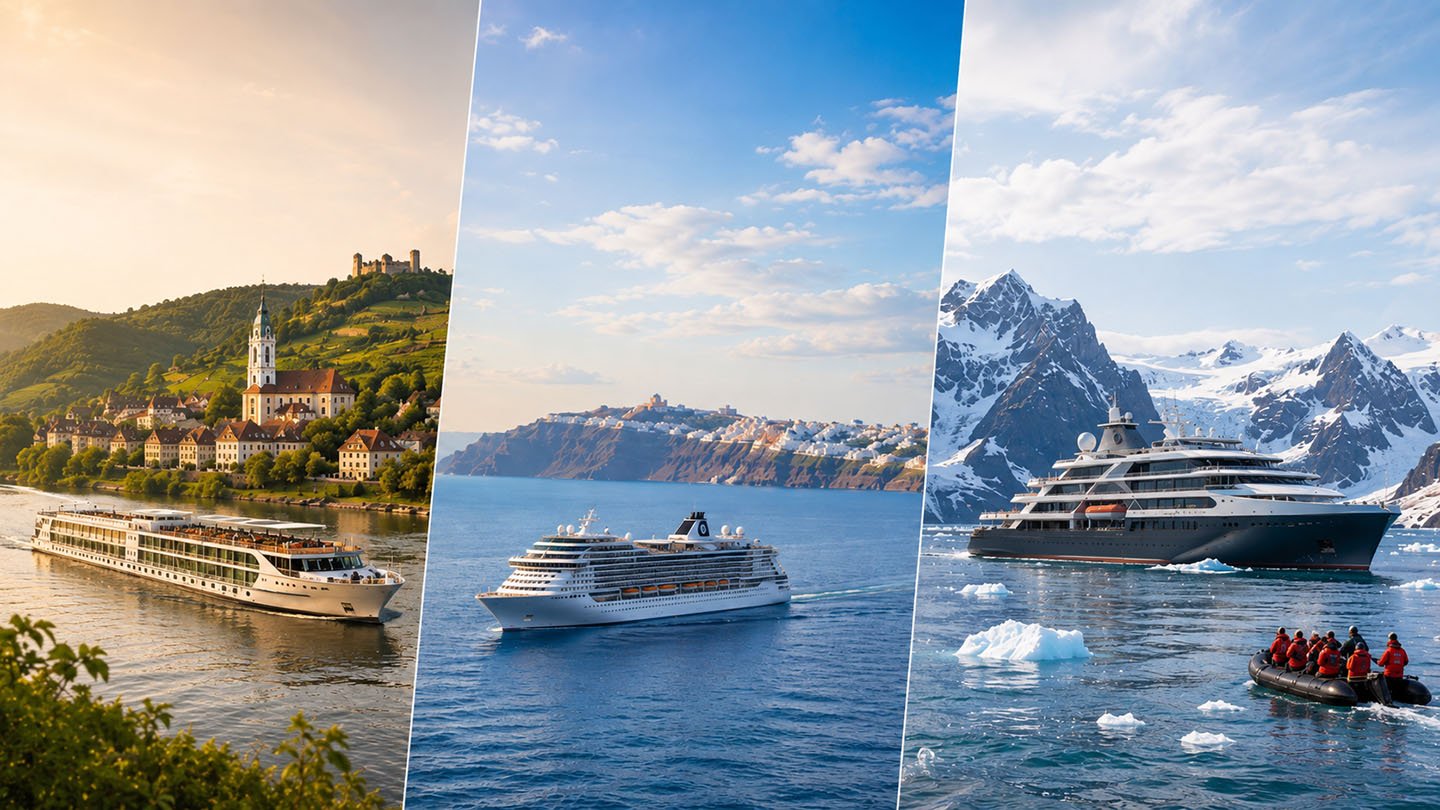
"Cruise" covers three genuinely different kinds of trip, and the differences go well beyond ship size. Picking the right category matters more than picking the right cruise line within it — a river cruise and an ocean cruise can feel like entirely different vacations even on the same budget, and choosing based on brand reputation alone, without first choosing the category, is one of the most common regrets first-time cruisers report.
Ocean cruises are what most people picture: ships carrying anywhere from a few hundred to several thousand passengers, built around onboard entertainment — theaters, casinos, multiple pools, a full evening program, sometimes water slides or a rock climbing wall — with itineraries that string together several countries or islands over a week or two, punctuated by sea days with nothing on the schedule at all except whatever the ship itself offers. This is the category with by far the widest range of ship sizes, price points, and target audiences, from budget-friendly family sailings to ultra-luxury small ships that happen to still carry the "ocean cruise" label.
River cruises sail much smaller vessels, typically 100 to 200 passengers, moving along a single river system — the Danube, the Rhine, the Mekong, the Nile — and docking in the center of a different town almost every single day, often within walking distance of the main sights. There's little onboard entertainment by comparison, because the entire model is built around being in a new place, on foot, every morning; evenings tend to be quieter, with a lounge, a lecture, or simply an early night ahead of the next day's walking tour. Meals and most excursions are typically included in the fare, and the ships themselves are shaped specifically to fit under low bridges and through narrow locks, which limits their size in ways an ocean ship never has to consider.
Expedition cruises use small, purpose-built ships — often under 200 passengers, sometimes far fewer — to reach places large ships physically cannot go: Antarctica, the Galápagos, remote Arctic fjords, parts of the Pacific with no real port infrastructure at all. Days are built around zodiac landings, wildlife viewing, and onboard lecturers — often actual scientists or naturalists — rather than pools or shows, and the price per day is usually the highest of the three categories, reflecting the cost of operating specialized vessels in remote regions with minimal infrastructure to support them.
What a typical day actually looks like differs more than the marketing photos suggest. On an ocean cruise, a sea day might mean a late breakfast, a few hours by the pool, a trivia contest, and a show after dinner — genuinely restful, with no obligation to do anything at all. On a river cruise, a typical day starts with an included walking tour of that morning's town, free time to explore independently in the afternoon, and dinner back onboard as the ship gets underway for the next stop overnight. On an expedition cruise, days often start early with a pre-breakfast zodiac landing, a second landing or activity in the afternoon, and an evening lecture recapping what you saw — genuinely active, with less unstructured downtime than either of the other two categories.
| Factor | River | Ocean | Expedition |
|---|---|---|---|
| Typical passenger count | 100–200 | Several hundred to a few thousand | Under 200 |
| Onboard amenities | Minimal — lounge, dining room | Extensive — theaters, pools, casino | Minimal — lecture lounge, observation deck |
| Itinerary style | Single river, daily port days | Multi-country, sea days included | Remote regions, zodiac landings |
| What's usually included | Most meals and excursions | Meals; excursions extra | Meals and excursions, often gear too |
| Typical price point | Mid to upper | Widest range, low to very high | Highest per day |
| Best for | Culture and cities, less motion-prone | Variety, families, first-time cruisers | Wildlife, remote destinations, active travelers |
Scroll the table sideways to compare all three categories.
Physical demands differ meaningfully. An ocean cruise is the most accommodating of the three for travelers with mobility limitations — large ships have elevators throughout, wide corridors, and shore excursions with options ranging from gentle to strenuous. A river cruise involves daily walking, often on cobblestones or uneven historic streets, with less flexibility to simply stay onboard and skip a day without missing the point of the itinerary. An expedition cruise typically requires the most physical capability of the three: getting in and out of a zodiac boat, walking on uneven or icy terrain, and standing for extended periods in cold weather are all part of a normal day, and most expedition lines are upfront about this in their booking materials for exactly that reason.
Cost per day tells a clearer story than the headline price. An ocean cruise can be booked from well under US$150 per person per day on the value end up to several hundred at the luxury end — the widest range of any category, which is exactly why comparing two "ocean cruises" by price alone says very little without knowing which end of that range each one sits at. River cruises cluster more tightly, generally in the US$300–US$500 per person per day range, reflecting their smaller scale and higher proportion of included extras. Expedition cruises typically start where river cruises end and run considerably higher, often US$600 per person per day and up, driven by the cost of specialized vessels, expert staff, and remote logistics with no economy of scale to fall back on.
Booking lead time differs meaningfully between the three. Popular expedition itineraries — a specific Antarctic season, a sought-after river sailing during peak tulip or Christmas market season — can sell out a year or more in advance, considerably further ahead than most ocean cruise bookings need to happen. If a specific departure date or season matters to you, river and expedition cruises reward booking earlier than an ocean cruise typically requires.
Seasonality shapes all three differently. Ocean cruise itineraries shift by region and season — Caribbean in winter, Mediterranean and Alaska in summer — with ships repositioning between them. River cruises follow the calendar of their specific river just as closely: European river cruises effectively pause each winter when water levels or ice make navigation impractical, while some routes run dedicated Christmas market sailings in that same window. Expedition cruises are the most tightly seasonal of all — Antarctica is only sailed during its own summer, roughly November through March, and simply isn't an option outside that window regardless of how far in advance you plan.
Ocean cruising itself spans a wide internal range worth understanding. A mega-ship carrying five or six thousand passengers is built around variety and scale — multiple specialty restaurants, water parks, Broadway-style productions — and suits travelers who want an all-in-one resort experience with a rotating backdrop. A mid-size ship, carrying one to two thousand, trades some of that scale for a calmer atmosphere and often more traditional itineraries. A small ocean ship, under a thousand passengers, starts to resemble the quieter pace of a river or expedition sailing while still offering the amenities and multi-country itineraries of an ocean cruise. Choosing "ocean cruise" as a category is really the first of two decisions — the ship size within it is the second, and arguably just as important.
It's possible, and increasingly common, to try more than one category over successive trips rather than assuming your first cruise defines what kind of cruiser you are. Many travelers who start with a mainstream ocean cruise to test whether cruising suits them at all later move toward a river cruise once they know they enjoy the format and want more destination depth, or toward an expedition cruise once budget and physical readiness align with a bucket-list destination like Antarctica or the Galápagos.
| Category | Typical trip length | Recommended booking lead time |
|---|---|---|
| River | 7–14 nights | 6–12 months for popular seasons |
| Ocean | 3–14+ nights | 3–9 months, less urgency |
| Expedition | 10–21+ nights | 12–18 months for peak season |
Scroll the table sideways to compare trip length and booking lead time.
The category matters more than the brand within it. Someone who loved an ocean cruise for the entertainment and easy pace can be genuinely disappointed by a river cruise's quieter evenings — and someone drawn to a river cruise for its intimacy can feel lost in a large ocean ship's crowds. Tell us what you actually want out of the days and nights, how much walking and activity you're looking for, and what kind of evenings suit you, and we'll point you at the category before we point you at a specific ship.
Keep reading
More from the Journal.
Ship Tour vs Independent Excursion — Which Should You Book?
Read the article
How to Organise a Group Cruise — From 10 to 50 People
Read the article
What to Pack for a 7-Night Cruise — the Complete List
Read the article