

Before You Board
6 min read
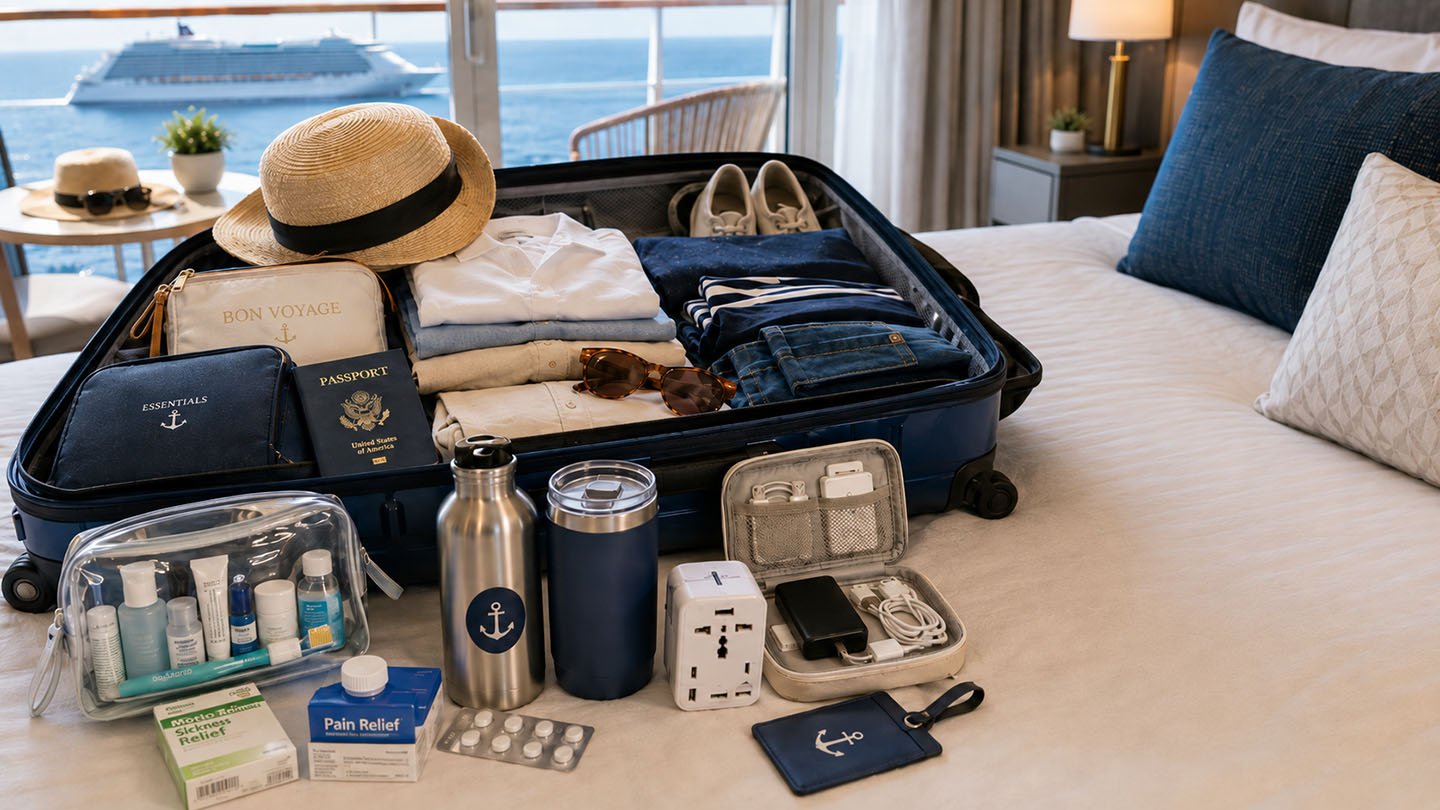
Packing for a week at sea is simpler than it looks once you know what the ship actually provides and what most first-time cruisers bring along for no reason. The list below covers a typical 7-night mainstream cruise; expedition and river sailings have their own specific gear lists worth checking against your cruise line's documents.
| Category | Bring | Notes |
|---|---|---|
| Documents & money | Passport, boarding pass, a physical credit card, some local cash for ports | Keep documents in your carry-on, not checked luggage |
| Daytime clothing | Swimwear, shorts, casual outfits — one per day plus a spare | Laundry service exists onboard if you'd rather pack lighter |
| Evening clothing | One or two smart-casual outfits, plus formal wear if your cruise has a formal night | Check your specific cruise line's dress code — it varies more than people expect |
| Health & toiletries | Prescription medication in original bottles, sunscreen, motion sickness remedy | Bring more medication than you think you'll need, in carry-on |
| Electronics | Phone charger, a portable battery, a non-surge-protected power strip | Surge-protected strips and extension cords are prohibited on most ships |
| Cabin extras | Magnetic hooks or clips, a small day bag for shore excursions | Cabin walls are usually magnetic — hooks add hanging space with no damage |
Scroll the table sideways to see the full list.
The cruise line provides bedding, towels, basic toiletries in most cabins, and increasingly a hairdryer — check your specific ship before packing your own. What you should not bring: irons, candles, and anything with an exposed heating element, which are confiscated at security for fire safety; the same goes for any surge-protected power strip, even though a basic non-surge strip is allowed.
Documents deserve their own checklist, not an afterthought. Beyond your passport and boarding pass, confirm what specific proof of citizenship your cruise actually requires — some shorter, closed-loop itineraries that begin and end at the same U.S. port allow a birth certificate and government photo ID instead of a passport, but a passport remains the safer choice in case of a missed port or a medical disembarkation partway through the trip. If your itinerary calls at a country requiring a visa arranged in advance, confirm the requirement and timeline well before packing day, since this is not something that can be resolved at the pier.
Formal night, if your cruise has one, is more relaxed than its name suggests on most mainstream lines these days — a collared shirt and slacks for men, a dress or nice separates for women, generally covers it comfortably, though some premium and luxury lines still lean more formal, with tuxedos and gowns genuinely present in the dining room. Check your specific cruise line's dress code documentation rather than assuming based on what a cruise looked like on television, since expectations vary more between lines than most first-time cruisers expect, and it's an easy thing to get right with five minutes of checking before you pack.
Climate changes the list more than the destination's name suggests. A Caribbean cruise calls for sun protection, swimwear, and light fabrics, with a layer only needed for a chilly, over-air-conditioned dining room in the evening. An Alaska cruise needs genuine layers — a waterproof outer layer, warm mid-layers, and real walking shoes — even in summer, since weather on deck and at port can shift quickly. A Mediterranean cruise in shoulder season sits somewhere in between, with cooler evenings than the daytime temperature suggests. Check the specific itinerary's likely weather for the sailing dates rather than assuming based on the region's general reputation.
What to carry on, specifically, on embarkation day itself. Checked luggage is typically delivered to cabins over the first few hours after boarding, sometimes not until early evening — pack a change of clothes, swimwear, any daily medication, chargers, and a phone battery pack in a carry-on bag so the first few hours onboard aren't spent waiting on a suitcase. This matters most for medication that can't simply wait a few hours, which should always travel in carry-on regardless of anything else.
Electronics and adapters depend entirely on the itinerary. A Caribbean cruise departing from a U.S. port needs no special adapter for U.S.-standard devices. An itinerary calling at international ports, or a cruise departing from a foreign port, can require a specific plug adapter — worth checking the ship's own cabin outlet standard, since it's often different from the standard in the ports you'll visit, and it's the cabin outlet that actually matters for charging.
Packing for children adds a few items worth listing separately: any specific snacks or comfort items for picky eaters, swim diapers if needed for the pool and splash areas, a basic first aid kit for scrapes, and identifying information — a card in a pocket, a wristband — for young children in case of separation in a crowded terminal or port. None of this is unique to cruising, but a week away from home's usual supplies makes it worth double-checking before you leave rather than assuming the ship's shop will have what you need.
A basic packing cube or compression bag system makes unpacking into a cabin's smaller closet space considerably easier than living out of a single large suitcase, and it's a small investment that pays off on every future trip, not just this one.
Whatever's left off this list by the time you sail is very likely available onboard or at the first port — sunscreen, a phone charger, basic toiletries are all sold in the ship's shop, generally at a premium. It's worth double-checking the list above rather than assuming, but a genuinely forgotten item is rarely a trip-ending problem.
Most first-time cruisers over-pack for formal night and under-pack for sun protection and layers. A week's worth of daytime outfits, one or two dressier options matched to your specific line's actual dress code, and a packing list built around your itinerary's real weather covers nearly every mainstream cruise comfortably, with room to spare in the suitcase for whatever you pick up along the way.
Keep reading
More from the Journal.

Why a Cruise Beats a Bus Tour — for Almost Every Type of Traveler
Read the article

Types of Cruise Cabins — and Which One Is Right for You
Read the article

What's Actually Included in Your Cruise Fare
Read the article