

Group Travel
10 min read
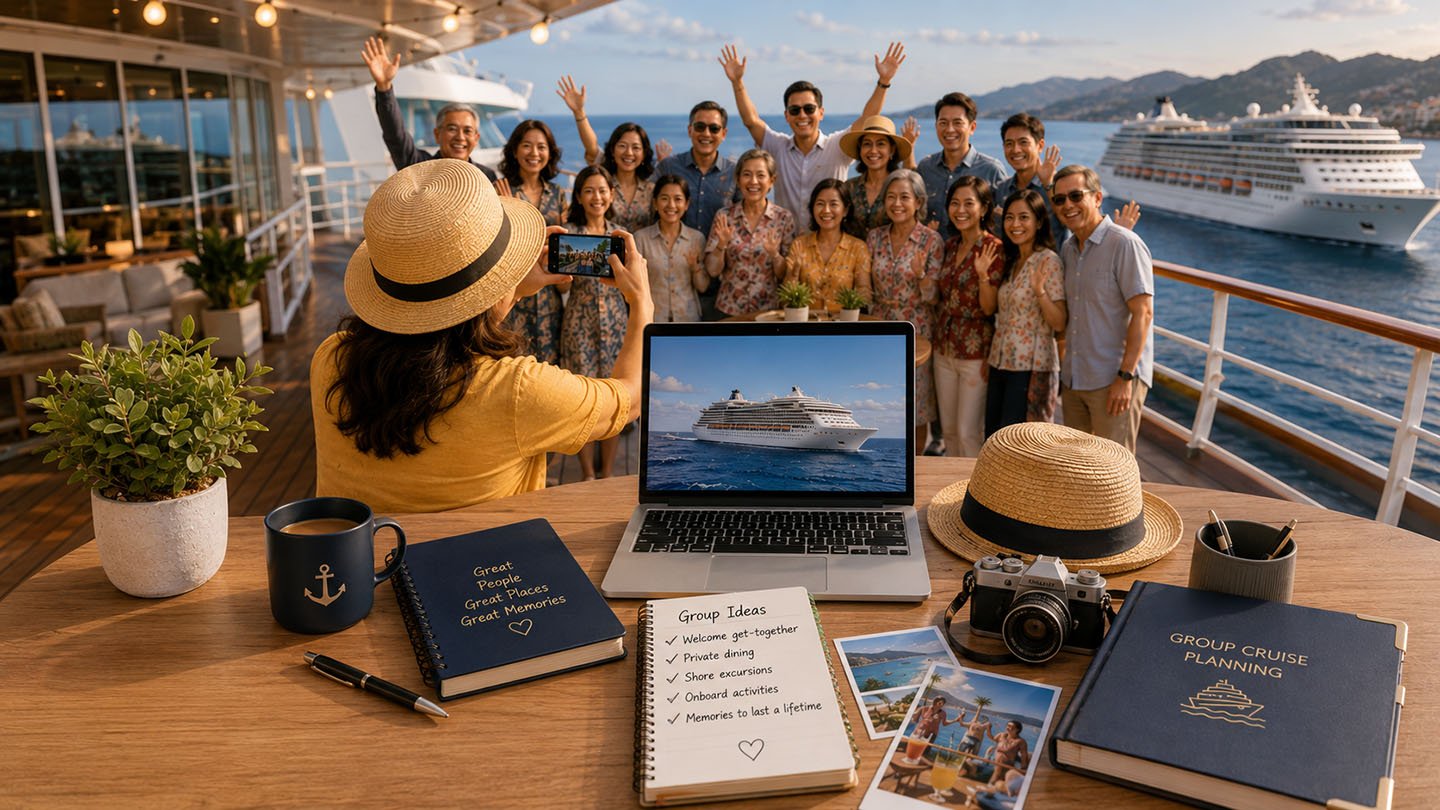
A group cruise — a family reunion, a milestone celebration, a friend group of ten or more — runs on the same booking system as an individual cabin, but a few things behave differently once more than a handful of cabins are involved, and planning around them early saves real headaches later, both for the person organizing it and for everyone else who just wants to show up and enjoy the trip.
Most cruise lines formally define a "group" starting around eight cabins, and offer meaningful perks at that size: a discount off the per-cabin rate, onboard credit that can be applied toward drinks, dining, or excursions, and often one complimentary or heavily discounted berth for the group organizer. Booking as a group also holds a block of cabins under one reservation, so your party can be assigned staterooms near each other rather than scattered across the ship — genuinely useful for a multi-generational family who wants grandparents, parents, and kids within easy walking distance of each other rather than a ten-minute walk apart.
Matching cabin types to a mixed group. A group traveling together rarely wants identical cabins — a couple celebrating an anniversary might want a balcony, while a family of four might prioritize a larger interior or connecting cabins over a view. A group booking can mix cabin categories under the same block while still qualifying for the group perks, which is worth knowing before anyone assumes everyone has to book the same thing to get the discount.
Dining is worth arranging before you sail rather than hoping it works out at check-in. Large parties should request a group reservation for the main dining room in advance — most ships can seat larger tables together, but only if the request goes in ahead of time rather than at the first night's dinner, when the maître d' is already working from a fixed seating plan.
| Task | When to handle it | Why it matters |
|---|---|---|
| Reserve the cabin block | As soon as dates are set | Locks in group pricing and keeps cabins together |
| Collect deposits | Within a few weeks of booking | Holds each cabin against the block |
| Request shared dining | Once the group is confirmed | Ships need lead time to seat large parties together |
| Coordinate shore excursions | 60–90 days before sailing | Group-size tours often need advance booking |
| Final payment & documents | Per the cruise line's final payment date | Missed deadlines can release cabins from the block |
Scroll the table sideways to see the full timeline.
Paying for a group booking. Cruise lines are flexible about who pays for what: one person can hold the reservation and collect payments from everyone else outside the booking system, or each cabin can pay its own deposit and final payment directly to the cruise line under the shared group block. The second option tends to reduce friction for the organizer, since it avoids one person fronting or chasing money on behalf of the whole group — worth deciding upfront which model your group will use, rather than assuming everyone's on the same page by default.
Private excursions for larger groups. Once a group reaches a certain size, it often becomes cost-effective to book a private shore excursion rather than joining the standard ship tour or splitting into smaller independent groups — a private boat charter, a reserved section at a beach club, or a bus reserved just for your party. This usually needs to be arranged well ahead of the sailing date, since private group logistics take longer to confirm than an individual booking.
Drop-outs are the part organizers dread most, and the honest answer is that the outcome depends entirely on timing and the specific cruise line's cancellation policy. Early on, a departing guest usually only loses their deposit. Closer to final payment, cancellation penalties climb — sometimes to the full fare — and the remaining group may need to absorb a higher per-cabin rate if the block's total no longer qualifies for the group discount. Most lines allow another traveler to take the open cabin at the same rate, which is almost always the better outcome if you can find someone, and it's worth having a backup name or two in mind before final payment rather than scrambling after someone drops.
A few things make the whole process smoother regardless of group size: one designated point of contact handling communication with the cruise line, a shared record of who has paid deposits and final payment, a group chat or shared document that keeps everyone updated at the same time rather than through a chain of individual messages, and passport and travel document deadlines circulated early — especially if your group includes travelers from different countries, since visa requirements can differ even for the same itinerary.
Onboard credit and perks are worth understanding in detail, not just as a lump sum. Group onboard credit is typically issued per cabin rather than per person, and can usually be applied toward gratuities, drink packages, specialty dining, or the onboard spa and shops — but it's rarely transferable to a cash refund if unused, so it's worth planning roughly how the group will spend it rather than letting it go unused by the end of the cruise.
Celebrating a special occasion as a group — a milestone anniversary, a big birthday, a reunion — often qualifies for extras beyond the standard group perks: a reserved area for a private cocktail hour, a decorated cabin door package, or a group photo session, depending on the cruise line. These typically need to be requested well ahead of the sailing date rather than arranged once onboard, and are usually far cheaper to book in advance through the cruise line than to improvise once you're already sailing.
Communication tools matter more than people expect for a group above about fifteen people. A simple shared document or spreadsheet tracking who has paid what, who has submitted documents, and who is attending which optional activity prevents the single most common group-trip problem: different people operating on different information. Assigning this to one person, rather than leaving it informal, consistently produces a smoother trip regardless of group size.
Document deadlines deserve their own timeline, separate from payment deadlines. Passport expiration requirements — many countries require six months of validity beyond the return date — and visa processing times vary by nationality and destination, and a mixed-nationality group can have wildly different lead times for the exact same itinerary. Circulating passport and visa requirements the moment the group is confirmed, rather than closer to sailing, avoids discovering a problem when there's no longer time to fix it.
A sample budget illustrates how the perks actually add up. An eight-cabin group booking a seven-night mainstream cruise might qualify for a modest per-cabin discount, several hundred dollars in combined onboard credit distributed across the block, and one complimentary or steeply discounted berth for the organizer — collectively worth a meaningful amount relative to the total group spend, though the exact figures depend entirely on the specific cruise line, ship, and sailing date, and are worth confirming before assuming a specific number applies to your group.
Different generations in the same group often want different amounts of activity, and planning for that upfront avoids friction mid-cruise. Grandparents may want a relaxed sea day by the pool while grandchildren want every shore excursion booked; adult siblings traveling with their own young families may want to split off for kid-friendly activities some days and regroup for dinner. Building in unstructured, un-obligated time — rather than a packed group itinerary for every single day — tends to produce a trip everyone genuinely enjoys, rather than one that feels like a forced march for whichever generation wanted a different pace.
Group travel insurance is worth considering separately from individual policies. Some insurers offer a group rate or a single policy covering the whole party, which can simplify claims if a shared issue — a delayed connecting flight affecting several travelers at once, for instance — affects the group collectively rather than one individual cabin.
| Cabins booked | Typical perks |
|---|---|
| 8–15 | Per-cabin rate discount, modest onboard credit |
| 16–30 | Larger onboard credit pool, one complimentary or reduced-rate cabin |
| 30+ | Negotiable perks, dedicated group coordinator from the cruise line |
Scroll the table sideways to see perks by group size.
We manage the cabin block, the paperwork, and the deadlines directly with the cruise line, so the group's point of contact only has to manage the group — and we can also help sort out the cabin mix, dining arrangements, and any private excursions before a single deposit is paid.
Keep reading
More from the Journal.
What to Pack for a 7-Night Cruise — the Complete List
Read the article
Why a Cruise Beats a Bus Tour — for Almost Every Type of Traveler
Read the article
Types of Cruise Cabins — and Which One Is Right for You
Read the article